
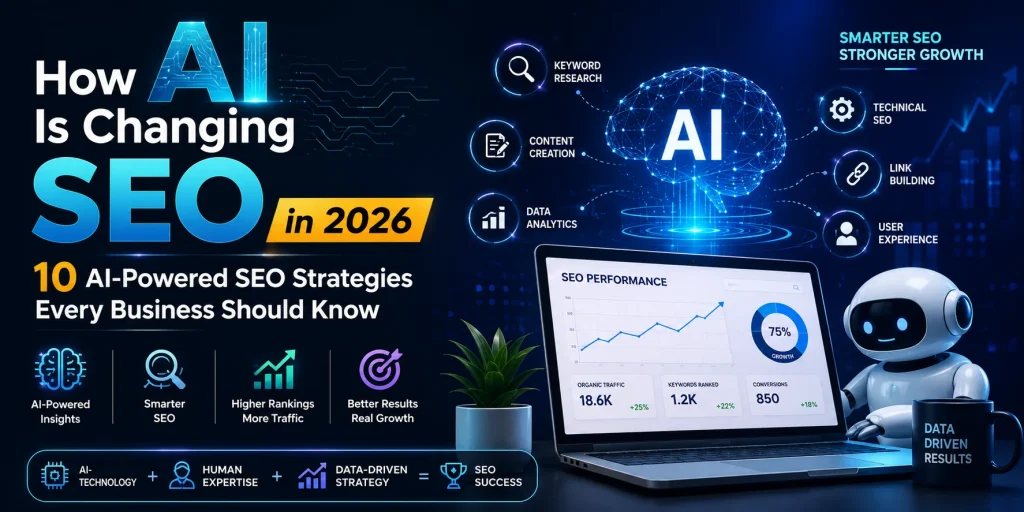
How AI Is Changing SEO in 2026: 10 AI-Powered SEO Strategies Every Business Should Know
Artificial Intelligence is transforming the way businesses approach digital marketing, and Search Engine Optimization is no exception. In 2026, SEO is no longer just about adding keywords to a webpage and building backlinks. Search engines are becoming smarter, users are searching in new ways, and businesses need more efficient strategies to stay competitive.
AI is helping marketers analyze large amounts of data, understand search behaviour, create better content, identify optimization opportunities and improve overall SEO performance.
However, one important thing needs to be understood: AI is not replacing SEO professionals. Instead, AI is changing how SEO professionals work.
The businesses that combine human expertise with AI-powered tools and data-driven strategies can create a stronger competitive advantage.
In this guide, we will explore how AI is changing SEO and discuss 10 AI-powered SEO strategies every business should know in 2026.
1. AI-Powered Keyword Research
Keyword research has always been the foundation of SEO. Traditionally, marketers would manually search for keywords and analyze search volume and competition.
AI can now make this process faster and more strategic.
AI-powered tools can help identify:
Relevant keyword opportunities
Long-tail keywords
Search trends
Topic clusters
User questions
Search intent
Content gaps
Instead of focusing only on individual keywords, businesses can use AI to understand the larger topics their customers are interested in.
For example, a business targeting SEO services can identify related topics such as:
How SEO works
Benefits of SEO
Local SEO strategies
AI in SEO
Technical SEO
SEO tools for businesses
This helps create a stronger content strategy around an entire topic rather than targeting random keywords.
2. Understanding Search Intent with AI
One of the biggest changes in modern SEO is the growing importance of search intent.
Search intent refers to the reason behind a user’s search query.
A person searching for:
“What is SEO?”
is looking for information.
Someone searching:
“Best SEO agency in Kolhapur”
is likely looking for a service provider.
AI can help marketers analyze search queries and categorize them based on intent, including:
Informational intent
Navigational intent
Commercial intent
Transactional intent
Understanding search intent helps businesses create content that matches what users actually want.
In 2026, successful SEO is not just about ranking for a keyword. It is about providing the most relevant answer or solution for the user’s search.
3. Creating Smarter Content with AI
AI has made content creation faster, but faster content does not automatically mean better content.
Businesses can use AI to support:
Content research
Blog outlines
Topic ideas
Frequently asked questions
Content structures
Content optimization
Content gap analysis
The best approach is to use AI as an assistant rather than allowing it to completely replace human expertise.
A strong AI-assisted content workflow looks like this:
Research → AI Assistance → Human Expertise → Editing → Optimization → Publishing
Human experience is still important because customers want useful, accurate and trustworthy information.
The goal should always be to create content that provides real value, not simply generate hundreds of articles using AI.
4. AI for Content Optimization
Publishing content is only the first step. Existing content also needs regular optimization.
AI can help businesses identify pages that may need improvement by analyzing:
Keyword relevance
Content quality
Missing topics
Search intent alignment
Internal linking opportunities
Content freshness
For example, an older blog post may still receive traffic but no longer answer the questions users are asking in 2026.
AI-assisted analysis can help marketers identify what information should be updated.
Regular content optimization can help businesses maintain relevance and improve the long-term performance of their website.
5. AI-Powered Technical SEO
Technical SEO ensures that search engines can effectively crawl, understand and index your website.
AI can support technical SEO by helping identify patterns and potential issues across large websites.
Some areas include:
Broken links
Duplicate content
Missing metadata
Crawl errors
Page speed issues
Structured data opportunities
Internal linking problems
AI can make technical analysis faster, especially for websites with hundreds or thousands of pages.
However, technical SEO still requires professional review. AI can identify possible issues, but experienced SEO professionals are needed to determine the right solution.
6. Personalized User Experience
Search engines increasingly focus on user experience.
A website that provides useful content but is difficult to navigate may struggle to convert visitors.
AI can help businesses understand user behaviour and improve experiences through:
Personalized content recommendations
Better website navigation
Customer segmentation
Behaviour analysis
Conversion optimization
For example, different visitors may be interested in different services.
A business owner may want SEO services, while another visitor may be looking for Google Ads or social media marketing.
AI-powered insights can help businesses understand these differences and create more relevant customer experiences.
7. AI and Voice Search Optimization
Voice search continues to influence how people search for information.
Voice searches are often more conversational than traditional typed searches.
For example, instead of searching:
“SEO agency Kolhapur”
a person might ask:
“Which is the best SEO agency in Kolhapur for small businesses?”
Businesses should optimize content for natural language questions.
AI can help identify:
Conversational search queries
Frequently asked questions
Long-tail keywords
Question-based searches
Adding useful FAQ sections and creating content that answers specific questions can improve visibility for conversational searches.
8. AI-Powered Competitor Analysis
Understanding your competitors is an important part of SEO strategy.
AI can help analyze competitors more efficiently by identifying:
Keywords competitors target
Content topics they cover
Content gaps
Ranking opportunities
Backlink patterns
Website structure
The goal is not to copy competitors.
Instead, competitor analysis should help you identify opportunities to create something better.
For example, if competitors have written basic articles about a topic, your business could create a more detailed guide with examples, FAQs, visuals and practical insights.
AI can speed up research, but strategy determines how those insights are used.
9. Predictive SEO and Trend Analysis
One of the most exciting applications of AI in SEO is predictive analysis.
AI can analyze patterns and identify emerging trends before they become highly competitive.
Businesses can use this information to:
Identify growing topics
Create content earlier
Understand changing customer behaviour
Plan seasonal campaigns
Discover new keyword opportunities
For example, if search interest around a particular technology or business trend is increasing, publishing useful content early can help establish authority before competition becomes stronger.
This gives businesses the opportunity to become proactive instead of always reacting to competitors.
10. AI for SEO Reporting and Decision-Making
SEO generates a large amount of data.
Businesses may track:
Organic traffic
Keyword rankings
Click-through rates
Conversions
Engagement
Backlinks
Page performance
AI can help organize and analyze this data faster.
Instead of spending hours manually reviewing reports, marketers can use AI-powered insights to identify:
What is working
What needs improvement
Which pages are losing traffic
Which topics are performing well
Where new opportunities exist
However, data only becomes valuable when businesses take action.
The best SEO strategies combine AI-powered insights with human decision-making.
The Future of AI and SEO
The future of SEO will become more focused on quality, relevance, user experience and trust.
As AI becomes more widely used, businesses that simply generate large volumes of low-quality content may struggle to build long-term authority.
Successful businesses will focus on:
Helpful content
Real expertise
Strong brand authority
User experience
Search intent
Accurate information
Original insights
Strategic use of AI
The future is not about choosing between AI and human marketers.
It is about combining both strengths.
AI provides speed and data analysis.
Humans provide creativity, strategy, experience and understanding.
Together, they can create more effective SEO campaigns.
How PG Brand Studio Uses AI-Powered SEO Strategies
At PG Brand Studio, we believe AI should support smarter marketing decisions.
We combine SEO strategy, human expertise, content marketing, performance insights and AI-powered tools to create effective digital marketing strategies.
Our approach focuses on:
AI-assisted keyword research
Search intent analysis
Content strategy
On-page SEO
Technical SEO
Local SEO
Competitor research
Performance tracking
The goal is not simply to follow trends. Our focus is on using the right technology and strategies to help businesses improve visibility, attract relevant audiences and achieve sustainable growth.
Conclusion
AI is changing SEO, but the fundamentals of successful search optimization remain important.
Businesses still need helpful content, strong websites, relevant keywords, excellent user experience and a clear understanding of their audience.
AI makes many SEO activities faster and more efficient, but technology alone cannot create a successful strategy.
The most successful businesses in 2026 will combine AI-powered tools with human expertise and data-driven decision-making.
By using these 10 AI-powered SEO strategies, businesses can improve their SEO process, discover new opportunities and prepare for the future of search.
Ready to grow your business with smarter SEO strategies?
PG Brand Studio combines AI, SEO and performance-focused digital marketing strategies to help businesses build stronger online visibility and achieve sustainable digital growth.